Field note
Mask R-CNN: instance segmentation as detection plus one branch
How adding a single mask-prediction branch onto an existing object detector turned 'find the objects' into 'find and precisely outline every object' — and the alignment fix that made small-object masks accurate.
Object detection finds bounding boxes; segmentation labels every pixel. Before Mask R-CNN, getting both — a precise outline for every individual object instance — generally meant two separate systems bolted together. Mask R-CNN got there by extending an existing, well-understood detector (Faster R-CNN) with one additional output branch, sharing the same backbone features rather than requiring a whole separate segmentation pipeline.
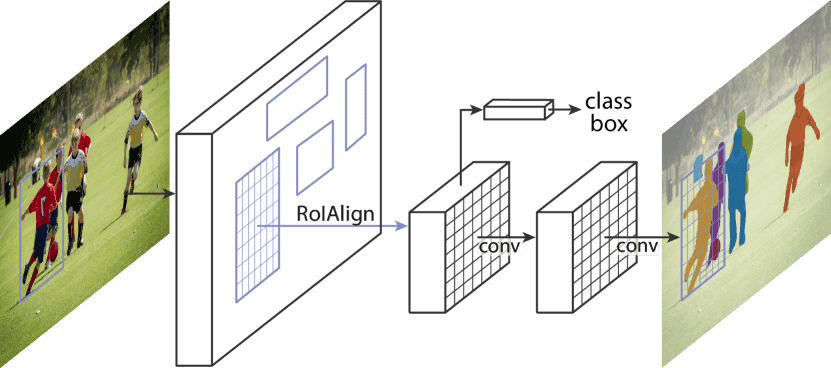
Detection plus one branch
Faster R-CNN already worked in two stages: propose candidate regions likely to contain an object, then classify each region and refine its bounding box. Mask R-CNN adds a third, parallel branch to that same architecture: for each detected region, predict a small binary mask marking exactly which pixels inside the box belong to the object. Classification, box refinement, and mask prediction all run off the same shared features — instance segmentation became “detection, plus a mask head,” not a separate problem requiring its own architecture.
The alignment bug that mattered more than it sounds
Pooling features for a candidate region traditionally used RoIPool, which snaps a region’s boundaries to the nearest feature-grid cell — a small quantization error that barely affects a bounding box, but visibly misaligns a pixel-precise mask, especially for smaller objects where the rounding error is large relative to the object’s size. Mask R-CNN replaced this with RoIAlign, which samples features at exact, non-quantized locations using interpolation instead of snapping to the nearest grid cell. This one fix was responsible for a substantial share of the accuracy improvement — a reminder that small implementation details in how features are extracted can matter as much as the headline architectural idea.
Why this mattered for bio-image analysis before SAM existed
Long before promptable foundation models, Mask R-CNN-based pipelines were a standard way to get instance segmentation — detecting and separately outlining cells, organelles, or particles in a dense field of view — by fine-tuning the detector on a labelled dataset for the object type of interest. It’s the direct predecessor to the “detect and outline every instance” task that SAM and its microscopy-specific descendants later approached with promptable, zero-shot methods instead of per-task fine-tuning.
Takeaways
- Instance segmentation was framed as “add a mask-prediction branch to an existing detector,” reusing shared features rather than requiring a wholly separate segmentation architecture.
- RoIAlign’s precise, non-quantized feature sampling — replacing RoIPool’s rounding to the nearest grid cell — disproportionately improved mask accuracy on small objects.
- Before promptable foundation models existed, fine-tuning a Mask R-CNN on a labelled dataset was the standard way to get per-instance outlines for cells, organelles, and particles in bio-image analysis.
Source
He, Gkioxari, Dollár & Girshick, Mask R-CNN, Facebook AI Research, 2017 — paper.
Continue through the concepts
Related notes
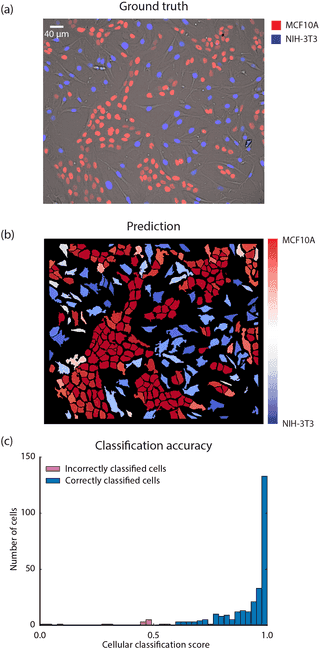 Van Valen et al.: CNNs learn live-cell tracking from ~100 annotated cells
One of the earliest demonstrations that a small amount of manual annotation was enough to train a CNN that out-tracked classical live-cell segmentation methods — the work that grew into DeepCell.
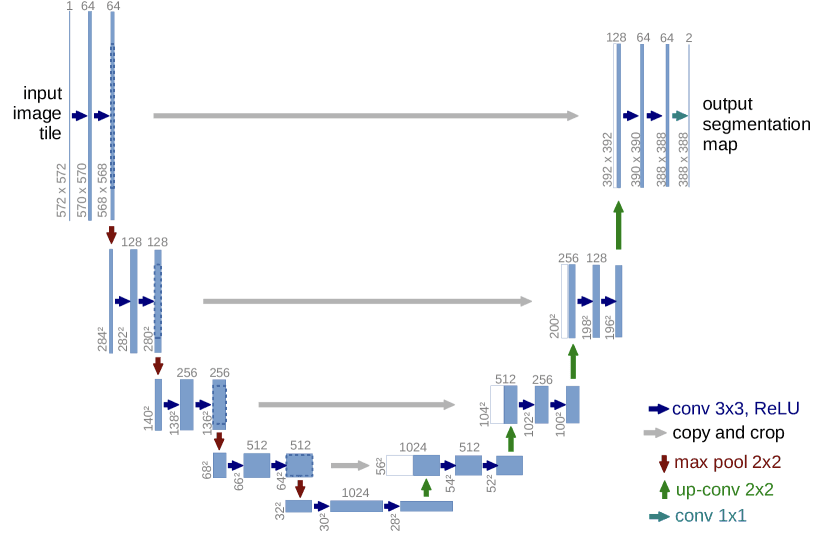 U-Net: the architecture built for too little data
Why the encoder-decoder-with-skip-connections shape became the default starting point for biomedical segmentation, and how it was designed specifically around having very few annotated images.
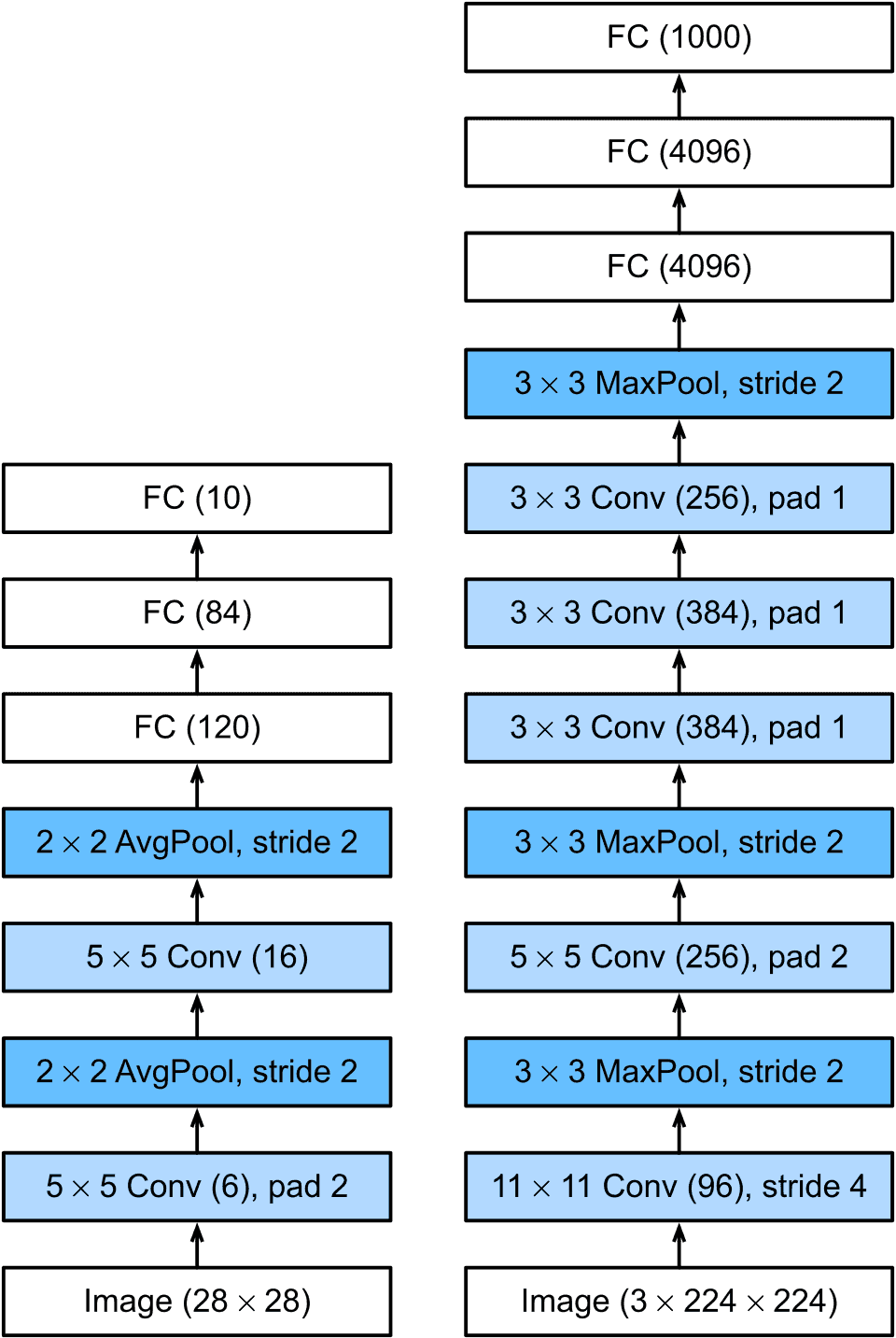 AlexNet: the result that ended the debate about deep learning
How a convolutional network trained on two GPUs cut ImageNet error by a margin large enough to reset computer vision, and why every microscopy segmentation model on this site descends from it.
 Cellpose: segmentation that generalises because it doesn't assume a shape
Why predicting a flow field toward each object's centre, instead of a mask directly, let one trained model segment cell types it had never seen — without retraining.