Field note
AlexNet: the result that ended the debate about deep learning
How a convolutional network trained on two GPUs cut ImageNet error by a margin large enough to reset computer vision, and why every microscopy segmentation model on this site descends from it.
Before 2012, image classification was built from hand-engineered features (SIFT, HOG, colour histograms) fed into a classifier like an SVM — a pipeline designed by researchers, not learned from data. AlexNet, a deep convolutional network trained on two consumer GPUs, cut the ImageNet top-5 error rate from around 26% to 15.3% — a jump so much larger than the usual year-over-year improvement that it ended the argument over whether deep learning actually worked at scale. Nearly every segmentation model referenced elsewhere on this site, from U-Net onward, is a direct descendant of the idea this paper proved.
What actually changed
Convolutional networks weren’t new in 2012 — LeCun’s work on digit recognition dated back to the 1990s. What AlexNet added was three ingredients arriving together at sufficient scale:
- Enough labelled data: ImageNet provided 1.2 million labelled training images across 1,000 categories, far larger than anything CNNs had trained on before.
- Enough compute: two GPUs, trained for about a week, made a network of this depth trainable in practical time — the model was even split across the two GPUs because it didn’t fit on one.
- Small fixes that mattered enormously: ReLU activations trained several times faster than the tanh/sigmoid units used before, dropout kept the huge fully-connected layers from memorising the training set, and aggressive data augmentation (crops, flips, colour jitter) stretched the effective dataset further.
None of these three alone was sufficient. Deep nets had been tried with less data or less compute and hadn’t shown this kind of result.
Why the margin, not just the win, mattered
Steady, incremental improvement wouldn’t have changed anyone’s mind about hand-engineered features. A jump of more than 10 percentage points in one year did. It meant the ceiling on hand-crafted features wasn’t a law of nature — it was just the ceiling of the previous approach. Within two to three years, hand-engineered features were essentially gone from top-performing vision systems, replaced by learned convolutional representations.
The architecture, briefly
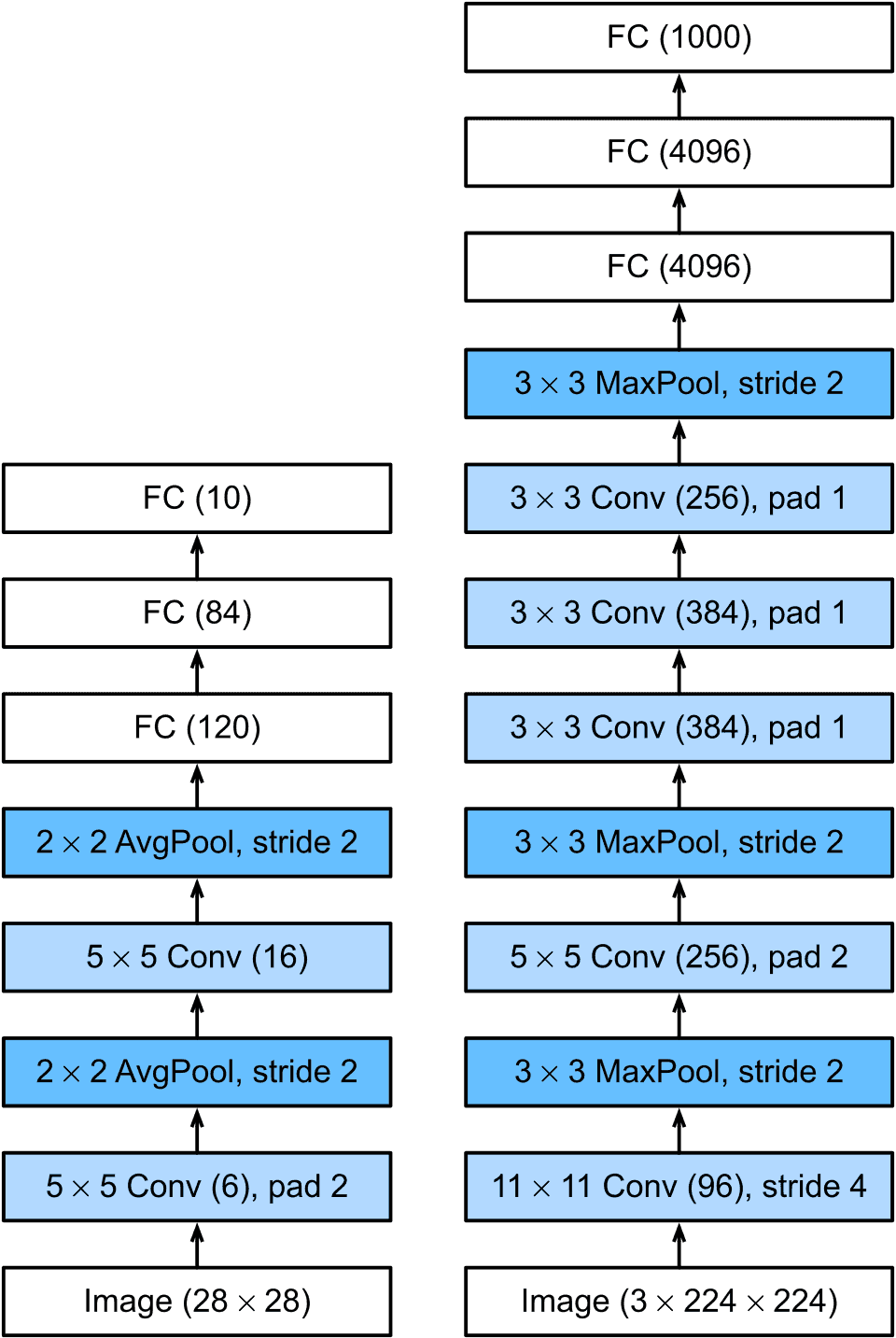
Eight learned layers: five convolutional layers followed by three fully connected layers, around 60 million parameters in total — modest by today’s standards, enormous for 2012 hardware. The now-familiar recipe of convolution → non-linearity → pooling, stacked and trained end-to-end with backpropagation, is exactly what every microscopy segmentation network still does today; the difference between AlexNet and U-Net or Cellpose is architecture and objective, not the underlying learning mechanism.
Takeaways
- The result wasn’t a new idea (convolutional networks existed) — it was proof that data, compute, and a handful of training fixes, combined at sufficient scale, made deep networks dramatically outperform hand-engineered pipelines.
- The size of the improvement, not just the direction, is what changed the field’s default approach almost overnight.
- Every architecture covered elsewhere on this timeline — U-Net, Cellpose, StarDist, SAM — inherits the basic convolution-and-backpropagation recipe this paper validated at scale; they differ in objective and architecture, not in the underlying mechanism.
- Data augmentation and regularisation (dropout) were as important to the result as the architecture itself — a lesson that still applies directly to training segmentation models on limited microscopy datasets.
Source
Krizhevsky, Sutskever & Hinton, ImageNet Classification with Deep Convolutional Neural Networks, NeurIPS 2012 — paper. See this entry in context on the Evolution timeline.
Continue through the concepts
Related notes
 CLIP: learning to see from what images are captioned, not labelled
How pairing images with their naturally occurring text turned classification into a similarity search, and why that's the conceptual ancestor of every open-vocabulary vision tool since.
 Van Valen et al.: CNNs learn live-cell tracking from ~100 annotated cells
One of the earliest demonstrations that a small amount of manual annotation was enough to train a CNN that out-tracked classical live-cell segmentation methods — the work that grew into DeepCell.
 DINOv2: features learned with no labels at all
How a self-supervised training recipe produced general-purpose visual features that match supervised pretraining — the exact constraint most scientific imaging labs work under: plenty of images, almost no annotation.
 DINOv3: fixing the feature drift that blocked longer self-supervised training
Why dense patch-level features used to degrade over very long self-supervised training runs, and how Gram anchoring fixed it well enough to be the first SSL model to beat weakly-supervised alternatives broadly.