Field note
DINOv3: fixing the feature drift that blocked longer self-supervised training
Why dense patch-level features used to degrade over very long self-supervised training runs, and how Gram anchoring fixed it well enough to be the first SSL model to beat weakly-supervised alternatives broadly.
Scaling self-supervised training further — more images, more parameters, longer training — should keep improving the learned features. In practice, earlier self-supervised vision models hit a specific failure mode instead: dense, patch-level features would degrade over very long training runs, even as coarser, image-level features kept improving. DINOv3, trained on 1.7 billion images with up to 7 billion parameters, is built around fixing exactly that problem, and became the first self-supervised model to outperform weakly-supervised alternatives across a broad task suite.
The problem: features degrade exactly where you need them most
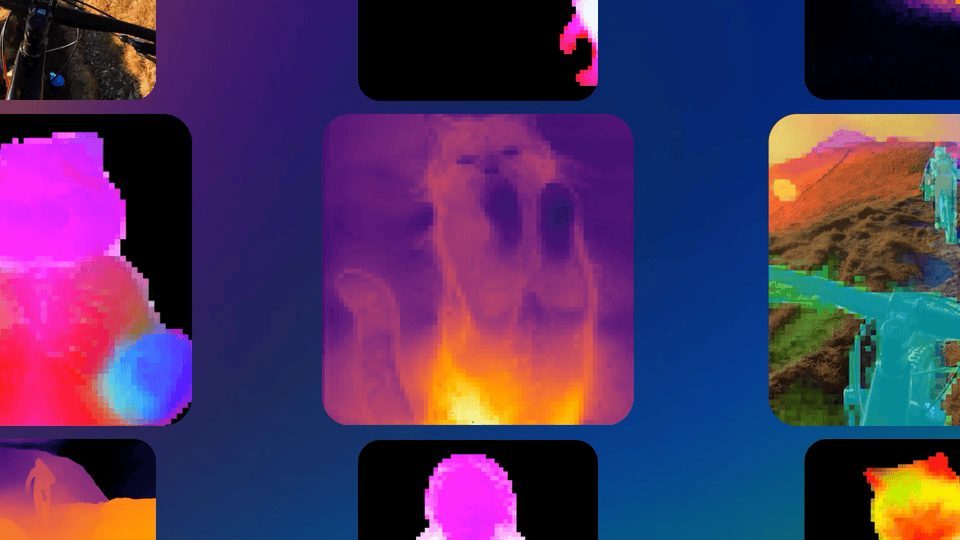
“Dense” features means one feature vector per image patch, not one per whole image — what a task like segmentation actually needs, since it has to make a decision at every location, not just describe the image as a whole. Image-level features (used for whole-image classification) kept improving with longer self-supervised training in earlier models, but the patch-level features needed for per-location tasks would drift and lose coherence over the same extended training. That gap meant scaling training duration further stopped being a reliable way to improve the tasks dense features are actually for.
Gram anchoring: keeping the geometry of the feature space stable
DINOv3’s fix, Gram anchoring, regularises training so that the relationships between patch features (their pairwise similarity structure, summarised by a Gram matrix) stay anchored close to a stable reference throughout the long training run, instead of drifting. Constraining the geometry of the feature space directly, rather than only the individual feature values, is what let training continue productively at a scale that previously caused dense features to degrade.
Why “first to beat weakly-supervised alternatives broadly” is the headline
Self-supervised models had matched supervised or weakly-supervised pretraining on individual benchmarks before. Beating weakly-supervised alternatives across a broad suite of tasks — not one favourable benchmark — is a stronger claim: it means the fix generalised, rather than trading dense-feature quality for image-level performance on the way to a bigger model.
Takeaways
- The specific problem being solved is dense (per-patch) feature degradation over very long self-supervised training runs — not simply “make the model bigger.”
- Gram anchoring constrains the relationships between patch features to stay stable, rather than regularising individual feature values directly.
- Broad task-suite improvement, not one benchmark win, is what distinguishes this from earlier self-supervised scaling attempts.
- For microscopy transfer learning specifically, stable dense features matter more than stable image-level features, since segmentation and detection both need a reliable decision at every location, not just a whole-image summary.
Source
Meta AI, DINOv3: self-supervised learning at unprecedented scale, 14 August 2025 — announcement.
Continue through the concepts
Related notes
 DINOv2: features learned with no labels at all
How a self-supervised training recipe produced general-purpose visual features that match supervised pretraining — the exact constraint most scientific imaging labs work under: plenty of images, almost no annotation.
 AlexNet: the result that ended the debate about deep learning
How a convolutional network trained on two GPUs cut ImageNet error by a margin large enough to reset computer vision, and why every microscopy segmentation model on this site descends from it.
 CLIP: learning to see from what images are captioned, not labelled
How pairing images with their naturally occurring text turned classification into a similarity search, and why that's the conceptual ancestor of every open-vocabulary vision tool since.
 SAM 2: keeping a mask's identity across a video
How a streaming-memory architecture let promptable segmentation extend from single images to video, tracking an object's identity through occlusion and motion in real time.