Field note
CARE: trading photons for computation
How a network trained on paired noisy/clean images turned denoising into something learnable — recovering usable data from far fewer photons than direct acquisition needs.
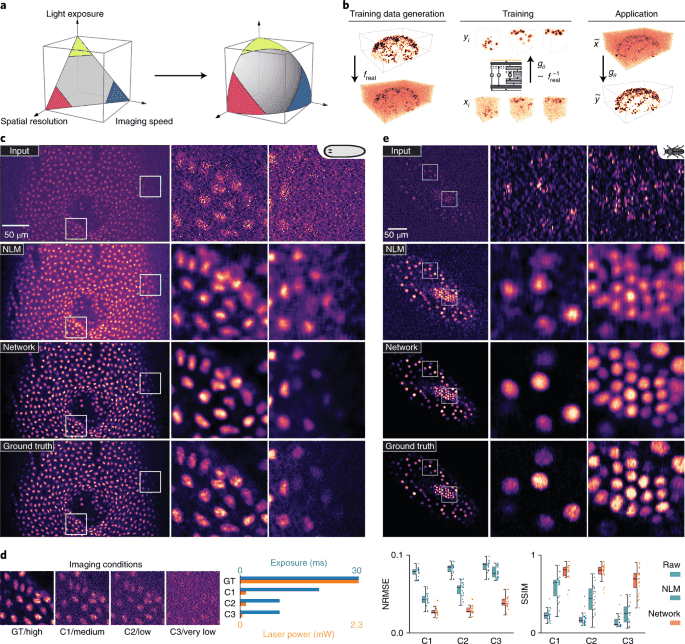
Live fluorescence imaging has a built-in conflict: more light gives a cleaner image, but also more phototoxicity and faster photobleaching — the very light needed to see the sample damages or destroys it. CARE (content-aware image restoration) reframed this as a learnable problem rather than a fixed physical trade-off: train a network on pairs of noisy, low-light images and their clean, high-light counterparts of the same sample, and it learns to restore acquisitions that were never captured at high quality in the first place.
Supervision from the same specimen, not a generic prior
The key experimental trick is acquiring paired data: the same field of view imaged both at low signal (fast, low-dose, or undersampled) and at high signal (slow, high-dose, or fully sampled), giving a direct noisy-to-clean training target. A U-Net-style network is trained to map the low-quality version onto the high-quality one. Because the network learns what this specimen type, on this microscope actually looks like when properly resolved, it restores detail more reliably than a generic denoising filter, which has no notion of what a “clean” version of the image should contain.
What it bought back
Once trained, the same network could recover usable images from up to 60-fold fewer photons than direct acquisition needed, produce near-isotropic 3D resolution from undersampled volumes, and support higher frame rates than the raw acquisition rate allowed — because the missing signal was reconstructed computationally instead of collected optically. That’s the trade at the centre of the paper: acquisition budget (light, time, sampling density) traded for compute, after the fact.
The limit worth remembering
A restoration network is only as good as the relationship it was trained on. Applied outside the imaging conditions, specimen type, or noise regime it learned from, it can produce plausible-looking but incorrect detail — a real risk for any generative restoration method, not a flaw specific to CARE. Paired, matched training data for the exact acquisition setting in use is what keeps restored images trustworthy rather than merely convincing.
Takeaways
- Denoising and restoration became a supervised learning problem once matched noisy/clean pairs from the same specimen were used as training data, rather than relying on a fixed mathematical denoising model.
- The gain is best understood as a trade: acquisition budget (photons, time, sampling) for compute, applied after the image is already captured.
- Restoration quality is bounded by how well the training pairs match the real acquisition conditions in use — it is not a universal fix independent of the data it was trained on.
Source
Weigert et al., Content-aware image restoration: pushing the limits of fluorescence microscopy, Nature Methods, December 2018 — paper.
Continue through the concepts
Related notes
 AlexNet: the result that ended the debate about deep learning
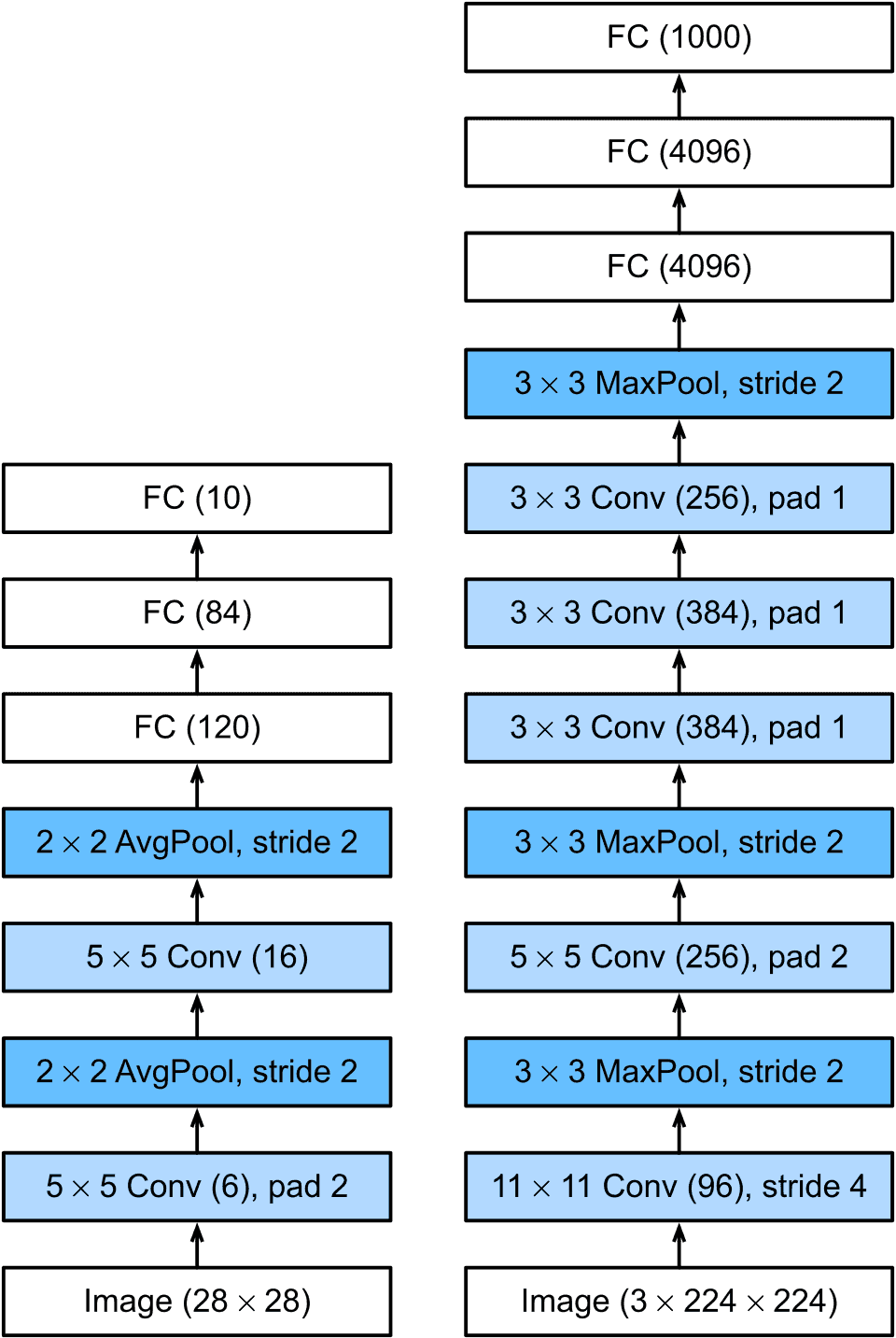
How a convolutional network trained on two GPUs cut ImageNet error by a margin large enough to reset computer vision, and why every microscopy segmentation model on this site descends from it.
 Batch effects and harmonization
Separate biological differences from acquisition-day, instrument, staining, or processing shifts without erasing real biology.
 Cellpose: segmentation that generalises because it doesn't assume a shape
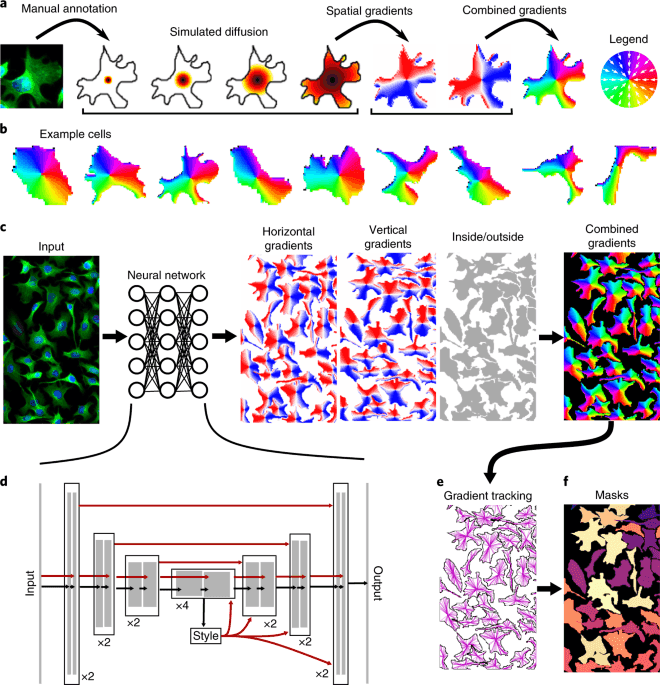
Why predicting a flow field toward each object's centre, instead of a mask directly, let one trained model segment cell types it had never seen — without retraining.
 CLIP: learning to see from what images are captioned, not labelled
How pairing images with their naturally occurring text turned classification into a similarity search, and why that's the conceptual ancestor of every open-vocabulary vision tool since.