Statistical note
Segmentation metrics: IoU, Dice, and boundary error
Overlap, class imbalance, object-level failure, and how to evaluate biological segmentation beyond one score.
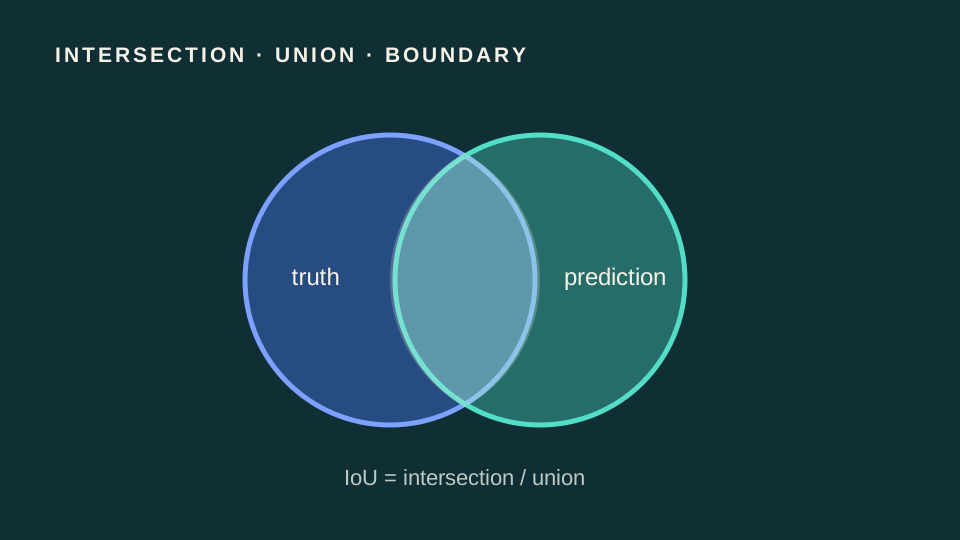
For predicted pixels and reference pixels ,
For a binary mask, Dice equals the pixel-level F1 score, and .
import numpy as np
from sklearn.metrics import jaccard_score, f1_score

truth = np.array([[0, 1, 1], [0, 1, 0], [0, 0, 0]]).ravel()
pred  = np.array([[0, 1, 1], [0, 1, 1], [0, 0, 0]]).ravel()
print("IoU", jaccard_score(truth, pred))
print("Dice", f1_score(truth, pred))
Case study: cell segmentation
Pixel overlap can look excellent even when adjacent cells are merged, because most foreground pixels remain correct. Add object-level matching, split/merge counts, boundary distance, per-image distributions, and downstream measurement error. Define how empty masks and small objects are handled.
Macro averaging gives each class equal weight; micro averaging pools pixels and can be dominated by background. scikit-learn supplies overlap primitives, while object and boundary metrics often require domain-specific code.
Functions: sklearn.metrics.jaccard_score, f1_score, confusion_matrix, and multilabel_confusion_matrix.
Continue through the concepts
Related notes
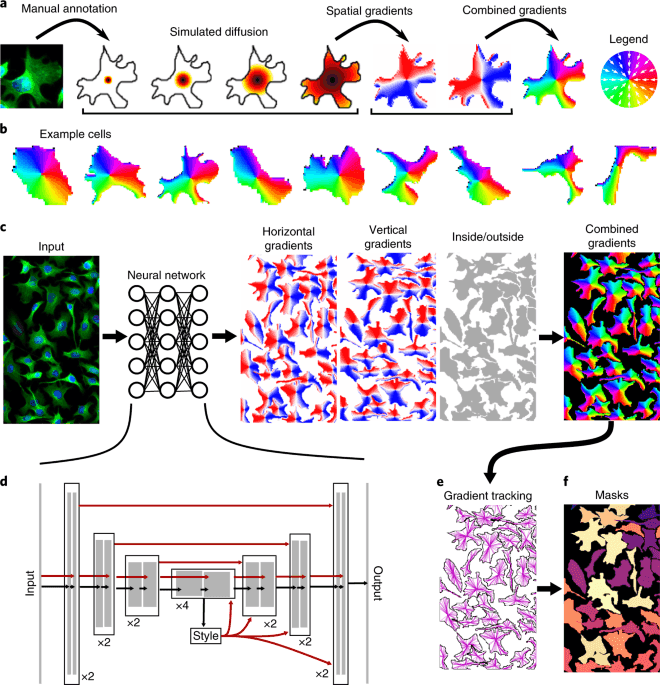 Cellpose: segmentation that generalises because it doesn't assume a shape
Why predicting a flow field toward each object's centre, instead of a mask directly, let one trained model segment cell types it had never seen — without retraining.
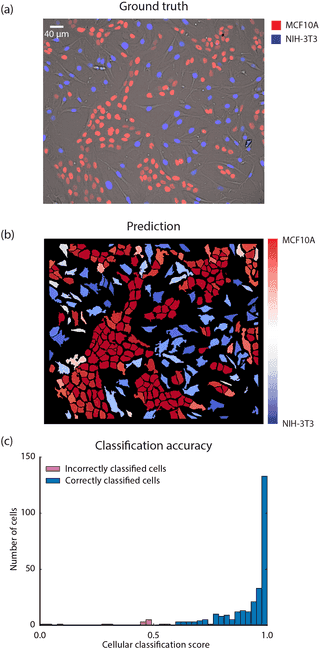 Van Valen et al.: CNNs learn live-cell tracking from ~100 annotated cells
One of the earliest demonstrations that a small amount of manual annotation was enough to train a CNN that out-tracked classical live-cell segmentation methods — the work that grew into DeepCell.
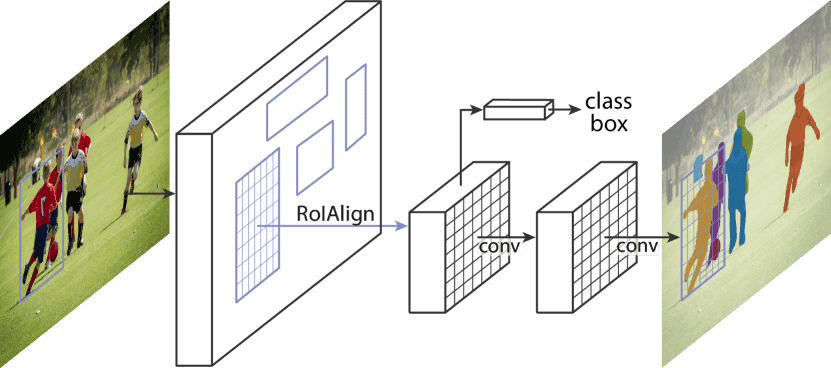 Mask R-CNN: instance segmentation as detection plus one branch
How adding a single mask-prediction branch onto an existing object detector turned 'find the objects' into 'find and precisely outline every object' — and the alignment fix that made small-object masks accurate.
 SAM 2: keeping a mask's identity across a video
How a streaming-memory architecture let promptable segmentation extend from single images to video, tracking an object's identity through occlusion and motion in real time.