Statistical note
Non-parametric tests: what they do and do not test
A guide to rank-based methods, permutation tests, distributional assumptions, and interpretation beyond the median myth.
Non-parametric does not mean assumption-free. These methods avoid specifying a small, fixed distributional family for every aspect of the data, but they still depend on the sampling design, independence, exchangeability, or assumptions about distributional shape.
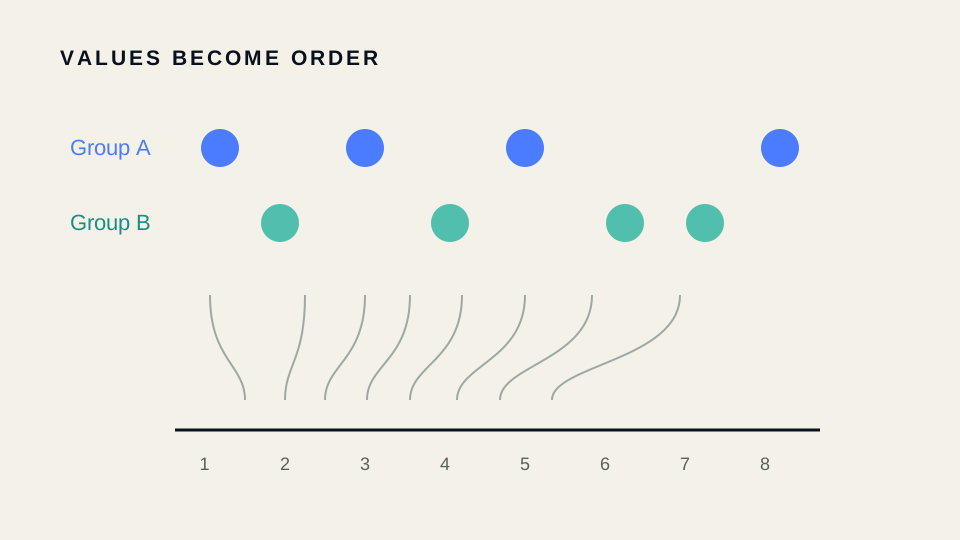
Rank-based tests
The Mann–Whitney test compares the ordering of observations between independent groups. It is not automatically a test of medians: that interpretation requires similarly shaped distributions. The Wilcoxon signed-rank test uses paired differences and assumes their distribution is symmetric.
If is the rank sum for sample , then
from scipy import stats

control = [4.1, 4.5, 4.9, 5.0, 5.2]
treated = [5.1, 5.4, 5.8, 6.2, 8.9]
print(stats.mannwhitneyu(treated, control, alternative="two-sided"))

before = [12, 14, 11, 15, 13]
after = [10, 13, 9, 12, 12]
print(stats.wilcoxon(after, before))
Permutation tests
A permutation test constructs a reference distribution by rearranging labels in ways justified by the null hypothesis. It can target a mean difference, median difference, correlation, or a custom statistic. Its key requirement is exchangeability under the null.
When they help
Rank and permutation methods are useful when outliers, skew, ordinal outcomes, or small samples make a conventional model questionable. They may sacrifice information by replacing values with ranks, and they do not repair dependence or poor experimental design.
Report the estimand
State exactly what difference the procedure targets, and accompany the test with an effect estimate and uncertainty interval whenever possible.
Case study: skewed cell-motility measurements
When a few cells travel exceptionally far, rank methods reduce their leverage. But cells within one movie remain dependent. Compute replicate-level summaries or use a hierarchical analysis before choosing a rank test.
Continue through the concepts
Related notes
 Huber and Tukey loss functions
A reference-level guide to huber and tukey loss functions: theory, assumptions, diagnostics, worked bioimaging analysis, exercises, and reporting.
Least-median and least-trimmed squaresA reference-level guide to least-median and least-trimmed squares: theory, assumptions, diagnostics, worked bioimaging analysis, exercises, and reporting.
M-estimation and robust regressionA reference-level guide to m-estimation and robust regression: theory, assumptions, diagnostics, worked bioimaging analysis, exercises, and reporting.
Quantile regressionA reference-level guide to quantile regression: theory, assumptions, diagnostics, worked bioimaging analysis, exercises, and reporting.