Statistical note
Effect sizes and confidence intervals
Moving from binary significance decisions to estimates of magnitude, direction, precision, and scientific relevance.
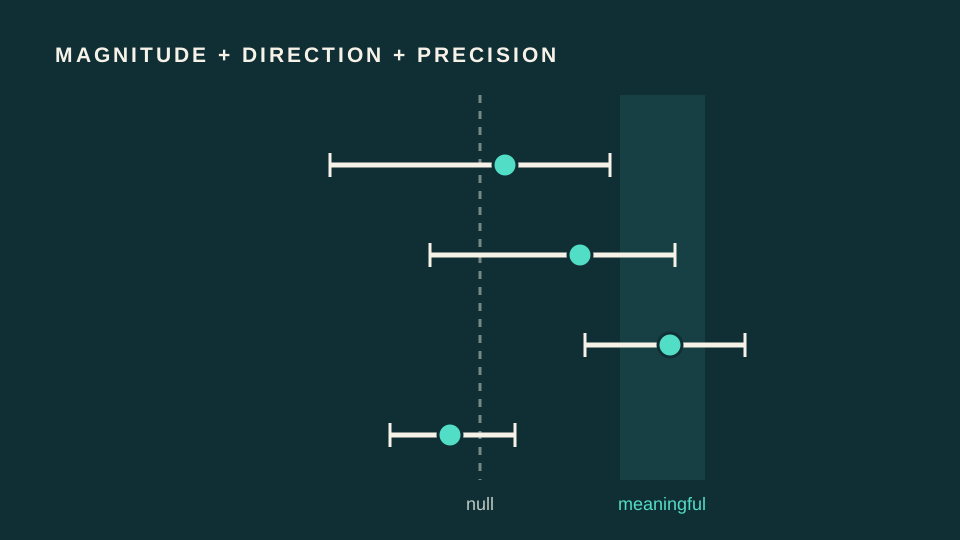
A statistical result should communicate how large an effect may be and how precisely it has been estimated. Effect sizes and confidence intervals provide that information more directly than a significance label.
Choose a meaningful scale
An absolute mean difference preserves the measurement unit. A ratio can be useful for multiplicative effects. Standardized differences such as Cohen’s d aid comparison across scales but can hide what the change means physically or biologically.
For two groups with pooled standard deviation ,
import numpy as np
from scipy import stats

a = np.array([10, 11, 9, 12, 10], dtype=float)
b = np.array([13, 12, 14, 11, 15], dtype=float)
pooled_sd = np.sqrt(((a.size-1)*a.var(ddof=1) + (b.size-1)*b.var(ddof=1)) / (a.size+b.size-2))
cohens_d = (b.mean() - a.mean()) / pooled_sd
ci = stats.ttest_ind(b, a, equal_var=False).confidence_interval()
print(cohens_d, ci)
Read an interval carefully
A confidence interval gives a range of parameter values compatible with the data and model under repeated-sampling logic. It is not a probability statement that the fixed true value lies inside this particular realized interval.
Precision is not importance
A narrow interval around a negligible effect is precise but may not be scientifically important. A wide interval spanning meaningful benefit and harm signals insufficient information, even when the p-value crosses an arbitrary threshold.
Define practical relevance
Whenever possible, specify a smallest effect of interest before examining the result. Interpretation can then focus on whether the interval excludes trivial effects, meaningful effects, or neither.
Case study: segmentation-induced area bias
A two-pixel mean boundary bias may be statistically detectable across thousands of cells but negligible for a downstream phenotype. Define tolerance in physical units, summarize effects per independent experiment, and compare the interval with that tolerance.
Continue through the concepts
Related notes
 Completeness and ancillary statistics
A reference-level guide to completeness and ancillary statistics: theory, assumptions, diagnostics, worked bioimaging analysis, exercises, and reporting.
Delta method and asymptotic normalityA reference-level guide to delta method and asymptotic normality: theory, assumptions, diagnostics, worked bioimaging analysis, exercises, and reporting.
Fisher information and the Cramér–Rao boundA reference-level guide to fisher information and the cramér–rao bound: theory, assumptions, diagnostics, worked bioimaging analysis, exercises, and reporting.
Likelihood-ratio, score, and Wald testsA reference-level guide to likelihood-ratio, score, and wald tests: theory, assumptions, diagnostics, worked bioimaging analysis, exercises, and reporting.