Statistical note
Cramér–von Mises goodness-of-fit test
Cramér–von Mises goodness-of-fit test: theory, interpretation, Python computation, and a scientific-imaging case study.
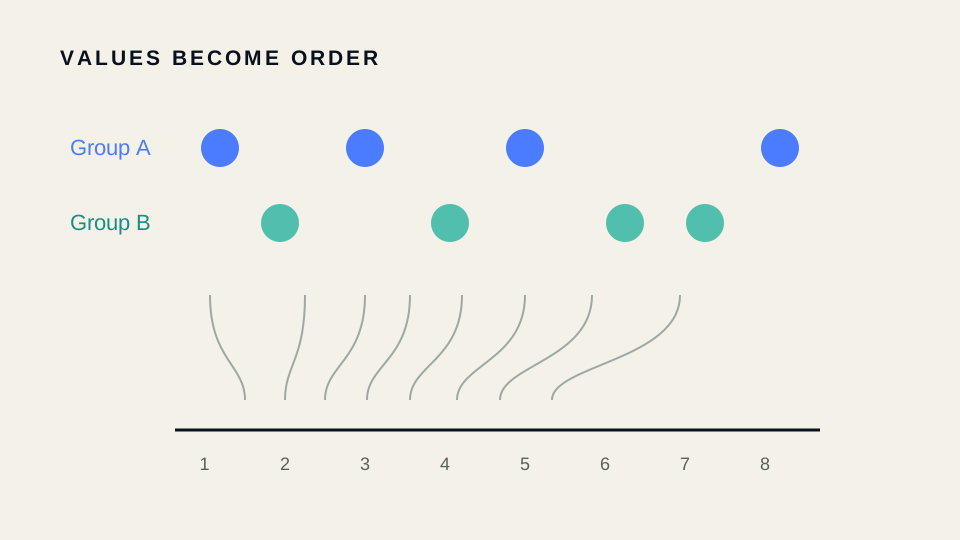
A test statistic orders datasets by incompatibility with a null model. Its reference distribution converts the observed statistic into a p-value.
Mathematical definition
The central quantity is
This expression states what is being counted, averaged, ranked, or compared. Its scale and direction must be interpreted in the context of the data and sampling design.
Compute it in Python
import numpy as np
from scipy import stats
x = np.random.default_rng(3).normal(size=25)
print(stats.cramervonmises(x, 'norm'))
The function is scipy.stats.cramervonmises. Inspect its current signature and return object in the official documentation for the version installed in your environment.
Interpretation and cautions
The design determines the test: independent, paired, repeated, categorical, or distributional questions are not interchangeable. Report an effect estimate and interval alongside the test.
A numerical value is not self-interpreting. Compare it with a baseline, uncertainty interval, operational threshold, or competing model, and retain the underlying observations or confusion counts.
Scientific-imaging case study
For integrated distribution discrepancy in imaging data, preserve the biological sampling unit and avoid treating correlated cells or pixels as independent replicates.
Split train, validation, and test data at the specimen or experimental level. Report variability across independent repeats so that the metric describes generalization rather than leakage.
Continue through the concepts
Related notes
One-sample t-testOne-sample t-test: theory, interpretation, Python computation, and a scientific-imaging case study.
Paired t-testPaired t-test: theory, interpretation, Python computation, and a scientific-imaging case study.
Welch independent t-testWelch independent t-test: theory, interpretation, Python computation, and a scientific-imaging case study.
Wilcoxon signed-rank testWilcoxon signed-rank test: theory, interpretation, Python computation, and a scientific-imaging case study.