Statistical note
Comparing more than two groups
ANOVA, Welch ANOVA, Kruskal–Wallis, and Friedman tests with assumptions, effect decomposition, and post-hoc cautions.
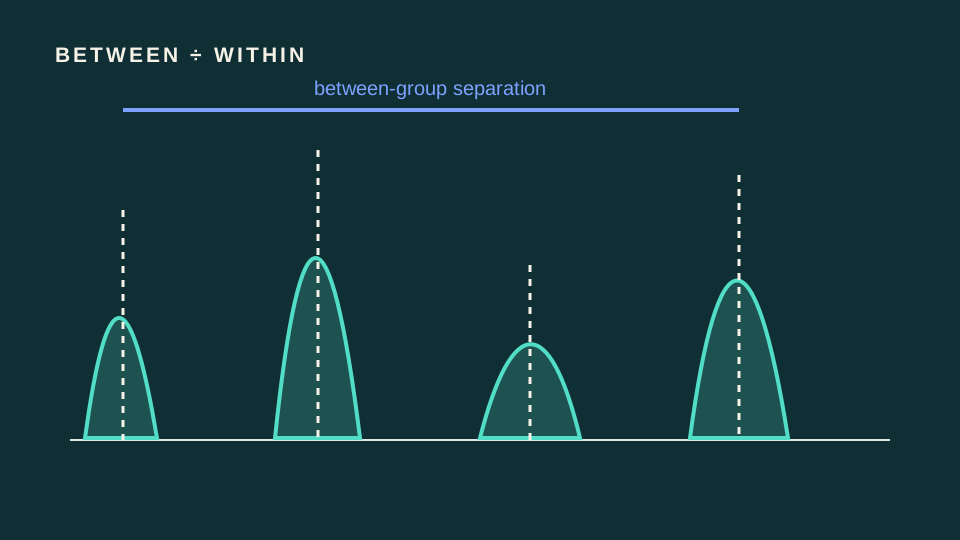
An omnibus test asks whether a set of groups is compatible with a shared model. Classical one-way ANOVA uses
so large between-group variation relative to within-group variation challenges equal means.
from scipy import stats

control = [10, 11, 9, 12, 10]
dose_1 = [12, 13, 11, 14, 13]
dose_2 = [16, 14, 17, 15, 18]

print(stats.f_oneway(control, dose_1, dose_2))
print(stats.kruskal(control, dose_1, dose_2))

# Repeated measurements on the same experimental units
print(stats.friedmanchisquare(control, dose_1, dose_2))
Choosing the family
Classical ANOVA assumes independent errors and equal group variances. Welch’s formulation relaxes equal variance. Kruskal–Wallis compares rank distributions for independent groups. Friedman handles blocked or repeated samples.
Case study: three microscopy treatments
Do not follow a significant omnibus result with every pairwise test uncorrected. Predefine contrasts or apply multiplicity control. Report group estimates and intervals; the omnibus p-value does not identify which groups differ or whether differences matter biologically.
Functions: scipy.stats.f_oneway, kruskal, friedmanchisquare, tukey_hsd, and dunnett.
Continue through the concepts
Related notes
ANCOVA: adjusted group comparisonsA reference-level guide to ancova: adjusted group comparisons: theory, assumptions, diagnostics, worked bioimaging analysis, exercises, and reporting.
MANCOVA with covariate adjustmentA reference-level guide to mancova with covariate adjustment: theory, assumptions, diagnostics, worked bioimaging analysis, exercises, and reporting.
MANOVA for multiple outcomesA reference-level guide to manova for multiple outcomes: theory, assumptions, diagnostics, worked bioimaging analysis, exercises, and reporting.
Mixed between-within ANOVAA reference-level guide to mixed between-within anova: theory, assumptions, diagnostics, worked bioimaging analysis, exercises, and reporting.